How We Use Duet to Grow Duet (and the SEO Kit to Copy It)
We grew Duet's organic clicks 18x by running our own AI agent as the SEO team. Here's the no-slop playbook — plus a free kit you can drop into Duet to copy it.



We grew Duet's Google Search Console clicks from 553 to 10,175 in one quarter — roughly 18x — by putting our own AI agent on the SEO work instead of hiring an agency. This is the exact loop we ran, framed honestly as search visibility and not revenue, plus a free kit that runs the same loop on your own site.
Quick Summary
Duet's organic search footprint grew 18.4x in clicks (553 → 10,175) and 21.3x in impressions (90,313 → 1,922,888) quarter over quarter, measured in Google Search Console for duet.chat. We did it by running our own AI agent as the SEO team — keyword research, briefs, drafts, schema, PRs, and weekly reporting — while humans owned positioning and killed weak angles. The same loop is packaged as a free kit you can drop into Duet to run on your own site.
Questions this page answers
- How do you grow SEO traffic with an AI agent?
- What is the no-slop AI SEO playbook?
- Is AI-generated content bad for SEO?
- How does Duet use Duet for its own content?
- How do you set up an AI SEO/AEO content pipeline?
- How can I copy this workflow on my own site?
Get the Duet SEO Pack
What actually happened: 553 to 10,175 clicks in a quarter
We grew organic clicks 18.4x and impressions 21.3x in a single quarter, measured in Google Search Console. Here are the two windows, side by side, with nothing hidden:
| Window | Clicks | Impressions | CTR | Avg position |
|---|---|---|---|---|
| Prior (Jan 13 – Apr 13 2026) | 553 | 90,313 | 0.612% | 7.59 |
| Current (Apr 14 – Jul 13 2026) | 10,175 | 1,922,888 | 0.529% | 9.03 |
Read those numbers honestly. This is Search Console visibility — impressions and clicks on Google — not revenue and not signups. CTR actually dipped (0.612% to 0.529%) and average position slipped (7.59 to 9.03), because the footprint got much wider: we now surface for thousands of long-tail queries we never touched before, and many of them rank lower than our original handful. A bigger net with a slightly looser weave still catches far more fish. And AI didn't cause every click — brand search, backlinks, and the product itself all move this line too.
The spark was our earlier case study, how we grew Google traffic 800% in 6 weeks with AI. This post is the boring, compounding continuation of that: same agent, same loop, one more quarter of it running.
Here is the important part, stated up front so nobody misreads it: this is not "publish 500 AI articles and call it SEO." That's slop, Google demotes it, and it wouldn't have produced these numbers. What follows is the opposite — a small number of genuinely useful pages, shipped fast, then improved from evidence.
What is the loop we actually run?
The loop is five steps, and we repeat it one page at a time. It isn't clever. It's just done consistently, by an agent that never gets bored of step four.
- Find a real search problem — a question people already type, that we can answer better than what ranks today.
- Make the page genuinely useful — answer-first, sourced, honest about tradeoffs.
- Ship it — into the actual codebase as a PR, indexed the day it merges.
- Measure what Google actually shows — not what we hoped, what Search Console reports.
- Fix the weak parts — truncated titles, thin sections, missing schema — then repeat.
Most SEO advice dies at step four. Humans don't enjoy pulling Search Console every week and diffing it against last week. An agent does it without complaint, which is why the loop actually closes instead of stalling after the exciting publishing part.
Strategy 1: Fix the machine before you write a word
Fix the technical foundation first, because content amplifies whatever structure it lands on. Before publishing in volume, the agent audited and shipped fixes for the parts of the site Google reads mechanically:
- Structured data (JSON-LD): Organization and SoftwareApplication on the homepage, Article and FAQPage on content, CollectionPage and ItemList on listings — so every page is machine-readable and eligible for rich results.
- Titles and meta: every title held under ~60 characters so it doesn't get truncated in the results page. In the 800% run, shortening one title doubled its CTR and increased clicks 57% even as impressions fell. Fit beats descriptiveness.
- Internal links: every new article links to at least three others, so nothing ships as an orphan page.
- Indexing and crawl rules: an auto-generating sitemap so new posts are discoverable the day they merge, plus explicit
robots.txtallow rules for AI crawlers (GPTBot, PerplexityBot, ClaudeBot, and friends) so the content can be cited in AI answers, not just blue links.
None of this is glamorous. All of it multiplies everything you publish afterward.
Strategy 2: Pick a wedge, not "SEO"
Don't target "SEO." Target a specific person doing a specific job, using a query they already type. Generic content competes with the entire internet; a wedge competes with almost nobody.
Our best-performing pages weren't generic tutorials. They sat at the intersection of a real keyword, a specific persona, and a concrete job — things like running Claude Code for founders, running Claude Code in the cloud, or turning AI skills into real workflows. In the earlier run, "Claude Code for Founders" out-clicked "Claude Code for Beginners" by roughly 10x on CTR, because it answered "how does this help my business?" instead of "how does this technology work?"
The test for a wedge: can you name the reader, the job, and the exact query in one sentence? If you can't, it's not a wedge yet — it's a topic, and topics don't rank.
Strategy 3: Use AI for throughput, not taste
Let the agent own throughput; keep taste with humans. This is the line that keeps the whole thing from turning into slop.
The agent does the labor that scales: keyword research across DataForSEO, competitor and SERP scans via Firecrawl, subject-matter gathering, fact-checking, citation collection, schema generation, the actual draft, the PR, and the weekly Search Console report. That's the 90% that used to bottleneck on human hours.
Humans do the 10% that decides whether it's any good: choosing the positioning, approving the angle, and — most importantly — killing the weak ones. An agent will cheerfully write a mediocre page about a topic nobody searches. A human looks at the brief and says "no, that angle is dead, don't write it." That veto is the difference between a content engine and a content landfill.
Run the loop with an agent, not a retainer
Duet runs the research, briefs, drafts, schema, and weekly reporting on its own cloud server — with your brand voice and connected tools in memory. Point it at your site and start the free first week. You keep the veto; it does the labor.
Strategy 4: Publish, then optimize from evidence
Ship first, then let Search Console tell you what to improve. Waiting for a page to be perfect before publishing just delays the day you get real data — and real data beats your guesses every time.
Once a page is live and indexed, the agent watches what Google actually does with it: which queries it surfaces for, where the CTR is leaking, which sections earn their own results. In the earlier run, Google started indexing individual sections of well-structured pages as separate results — free extra entries we did nothing special to earn beyond clear headings.
This is also where AEO (answer engine optimization) lives. Structure each page answer-first — a direct sentence under every question-shaped heading, a liftable summary near the top — so an AI assistant can quote it cleanly in a generated answer. Same discipline that helps Google's snippets helps you get cited by ChatGPT and Perplexity. For the strategy view of this, see how to build an AI SEO strategy without an agency.
How do we use Duet to grow Duet?
Our content pipeline is a Duet Kanban board, and every article is a card that moves across it. This is the dogfooding part — we run our own SEO on the same product we sell.
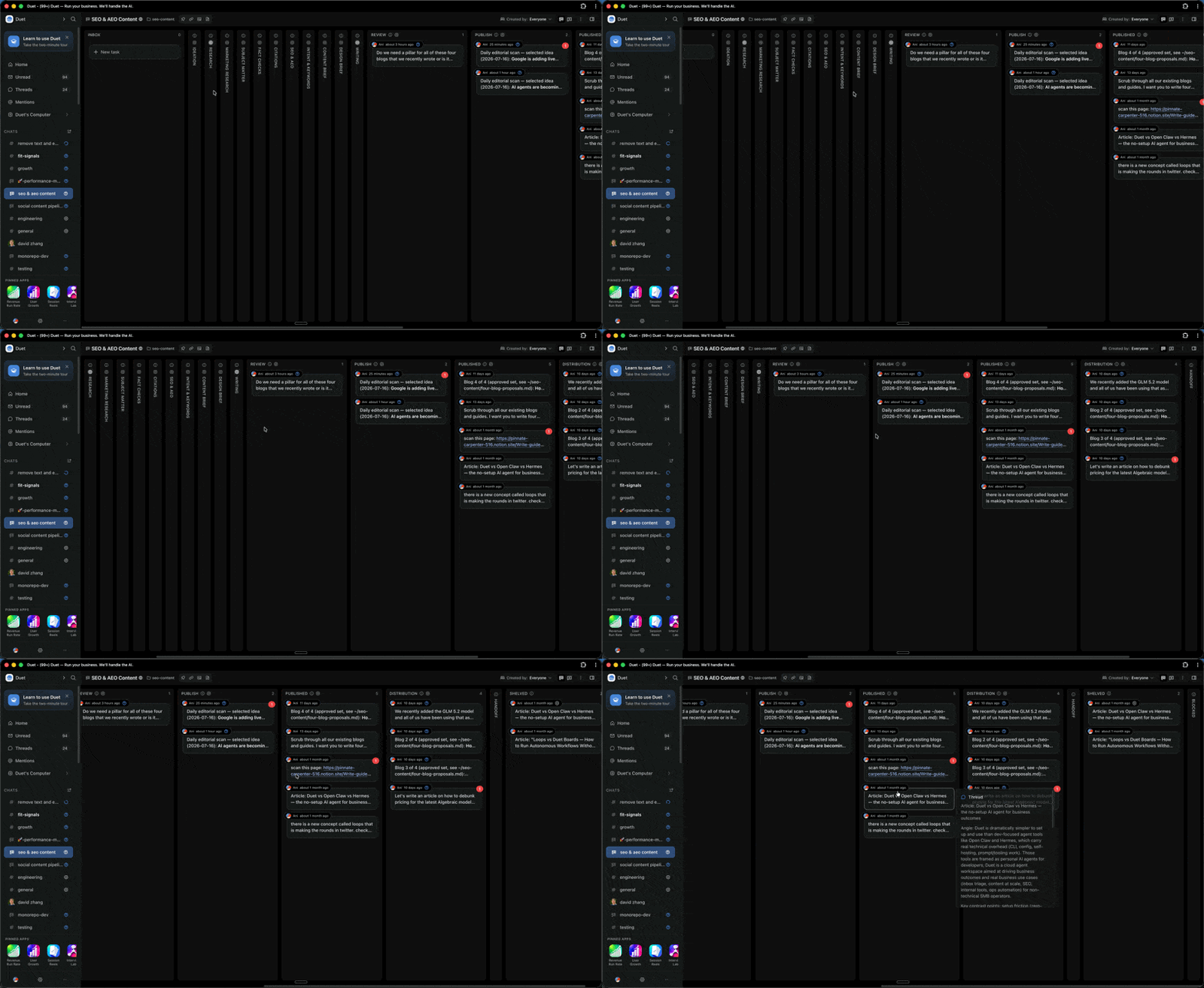
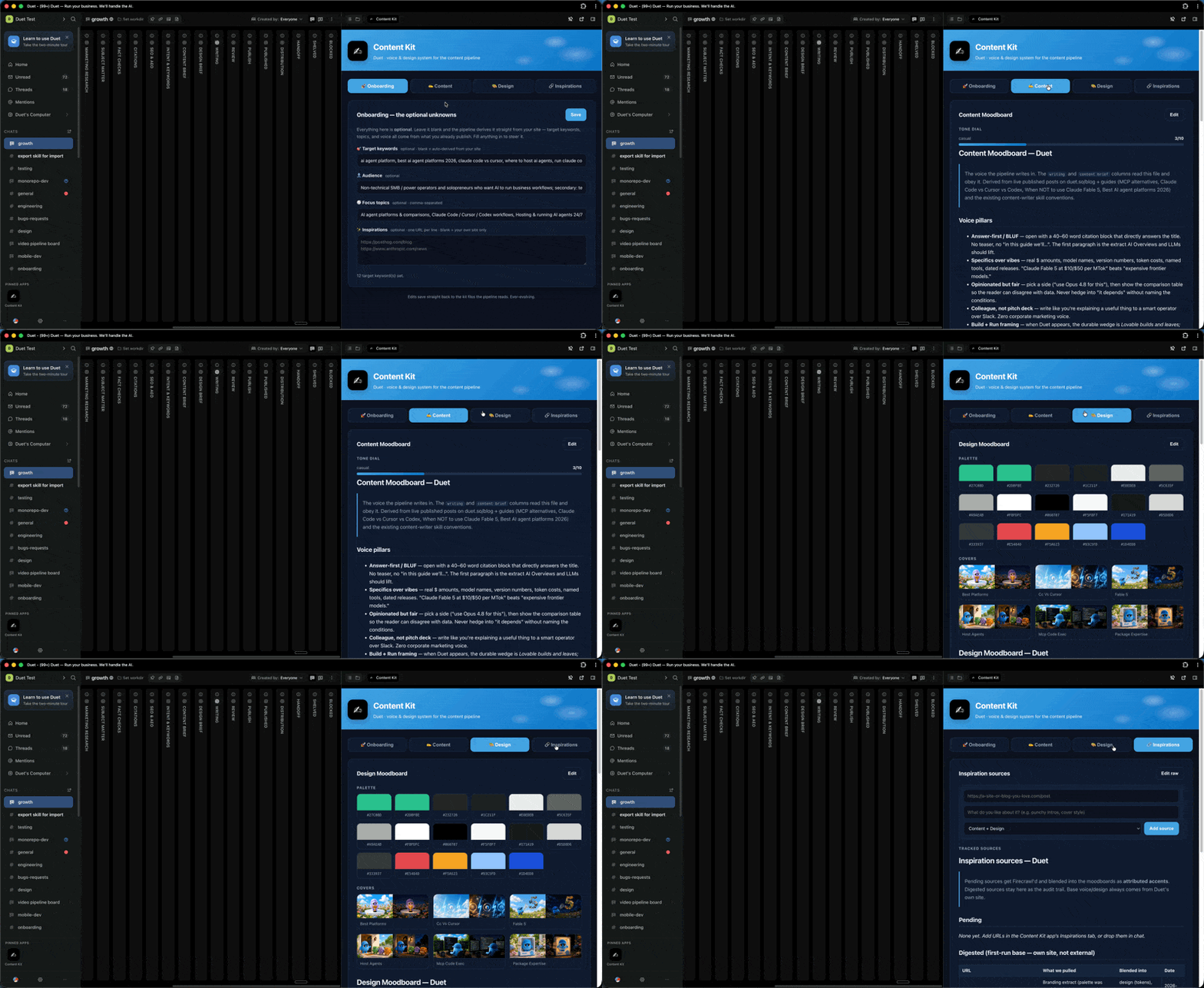
Each card walks one article through the full assembly line: ideation → research → marketing research → subject matter → fact checks → citations → SEO & AEO → keywords → content brief → design brief → writing → review → publish → distribution. The agent does the labor at each column, grounded in a per-workspace Content Kit — a voice moodboard and a design moodboard derived from our own site's brand and existing content — plus Google Search Console, DataForSEO, and Firecrawl.
Humans gate two columns and only two: positioning (is this the right angle?) and publish (is this good enough to ship under our name?). Everything between is the agent's job. Every week, it reports Search Console movement straight back into the channel, so the loop's step four happens on a schedule instead of whenever someone remembers.
This post is not a description of that pipeline. It's an output of it — this card moved through those columns like every other. If you want the deeper version of why the agent that runs the workflow matters more than the one that builds it, we wrote that up in who runs your AI agent after you build it.
How do you copy this on your own site?
You copy it by handing Duet the same kit we use and pointing it at your site instead of ours. The kit adapts to your brand, voice, and search data — it does not publish about Duet. Here's the whole setup:
- Download the Duet SEO Pack. Grab the kit here: duet-seo-pack.zip. It contains the pipeline skill and the Content Kit templates.
- Open a chat with Duet. If you're new, start the free first week — no card required to begin.
- Drag the zip into the chat. Just drop the file straight into the conversation.
- Tell Duet what you want. Something as plain as: "Use this pack to set up an SEO/AEO content pipeline for my site."
- Let it build your setup. Duet unpacks the zip, installs the skill, builds your Content Kit from your own brand and voice, and turns a channel into your content board.
- Add your first idea and run the loop. Drop in an idea, approve the positioning, and let the agent run the research-to-publish sequence. You keep the veto at positioning and publish; it does everything in between.
From there it's the same weekly rhythm we run: ship a page, read what Google shows, fix the weak parts, repeat. On your keywords, in your voice, about your product.
Is AI content actually safe for SEO?
Yes — when it's accurate, specific, and useful, Google ranks it fine regardless of who or what wrote it. Google demotes thin, duplicated, unhelpful content, not AI content as a category. The reason mass-produced AI articles fail isn't the AI; it's that nobody applied taste, so the pages were interchangeable and empty. The whole point of keeping the human veto on positioning and publish is to never ship that.
The honest takeaway is unglamorous: there's no growth hack here. It's the same loop, run one page at a time, by an agent that doesn't get tired of step four — find the problem, make the page useful, ship it, measure it, fix it, repeat. We just don't have to be the ones pulling the report every week anymore.
Frequently asked questions
How much did Duet's organic traffic actually grow?
Google Search Console clicks for duet.chat went from 553 in the Jan 13 – Apr 13 2026 window to 10,175 in the Apr 14 – Jul 13 2026 window — about 18.4x — and impressions grew from 90,313 to 1,922,888, about 21.3x. These are search-visibility numbers, not revenue.
Why did CTR and average position get slightly worse if traffic grew? Because the footprint widened. Ranking for thousands of new long-tail queries adds many lower-position, lower-CTR entries, which drags the averages down even as total clicks rise sharply. It's the expected shape of going from a handful of pages to broad topical coverage.
Is publishing AI-generated content bad for SEO? No, when it meets quality standards. Google penalizes thin, duplicate, or unhelpful content regardless of authorship. AI content that is accurate, well-structured, and genuinely useful ranks normally — which is why a human still owns positioning and the publish decision in this workflow.
What does the Duet SEO Pack include? The pipeline skill plus Content Kit templates — a voice moodboard and a design moodboard structure. When you run it, Duet builds your Content Kit from your own brand and turns a channel into a content board with columns from ideation through distribution.
Do I need to be technical to run this? No. You drop the zip into a chat with Duet, tell it what you want in plain language, and approve the angle and the final draft. The agent handles research, briefs, drafts, schema, and reporting.
What do humans still decide? Positioning and publish. Humans choose the angle and kill weak ones before writing, and approve the finished page before it ships. Everything between those two gates is the agent's job.